We will continue with more words on the topic of heat transfer.
Convection heat transfer coefficient.
Verb.
The convection heat transfer coefficient, h, can be defined as: The rate of heat transfer between a solid surface and a fluid per unit area per unit temperature difference.
Example: Despite the complexity of convection, it is observed that the rate of heat transfer by convection is proportional to the temperature difference and is conveniently expressed by Newton's law of cooling.
es: Coeficiente de transferencia de calor por convección.
Critical Reynold’s number.
Verb.
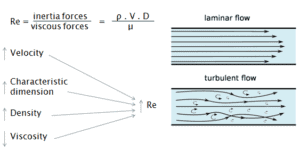
The critical Reynolds number is associated with the laminar-turbulent transition, in which a laminar flow becomes turbulent.
Example: The Reynolds number depends on the speed of the fluid, the pipe diameter, or equivalent diameter if the conduction is not circular, and the kinematic viscosity or, failing that, density and dynamic viscosity.
es: Número crítico de Reynold.
Friction Coefficient
Verb
The coefficient of friction or coefficient of friction links the opposition to sliding offered by the surfaces of two bodies in contact according to the intensity of the mutual support they experience.
Example: The value of the coefficient of friction is characteristic of each pair of materials in contact; it is not an intrinsic property of a material. It also depends on many factors such as temperature, surface finish, relative speed between surfaces, etc.
es: Coeficiente de fricción.
Kinematic viscosity
Verb
Kinematic viscosity is a measure of the internal resistance of a fluid to flow under gravitational forces.
Example: Viscosity can be measured and reported as dynamic (absolute) viscosity or as kinematic viscosity.
es: Viscosidad cinemática
Laminar flow.
Verb.
It is called laminar flows, the movement of a fluid when it is ordered, stratified and smooth.
Example: In laminar flow the fluid moves in parallel sheets without intermingling and each fluid particle follows a path called the streamline.
es: Flujo laminar.
Nusselt number.
Verb.
The Nusselt number (Nu) is a dimensionless number that measures the increase in heat transfer from a surface through which a fluid flows (heat transfer by convection) compared to heat transfer if it occurred only by conduction.
Example: Thus, for example, in heat transfer within a cavity by natural convection, when the Rayleigh number is less than 1000 it is considered that the heat transfer is solely by conduction and the Nusselt number takes the value of the unit.
es: Número de Nusselt
Prandtl number.
Verb.
The Prandtl number (Pr) is a dimensionless number proportional to the quotient between the diffusion rate of the amount of moment (viscosity) and the thermal diffusivity.
Example: In mercury, heat conduction is very effective compared to speed, or the ability to transmit moment, therefore the Prandtl number is low as in other liquid metals.
es: Número de prandtl.
Reynold number.
Verb.
The Reynolds number (Re) is a dimensionless number used in fluid mechanics, reactor design, and transport phenomena to characterize the motion of a fluid. Its value indicates whether the flow follows a laminar or turbulent pattern.
Example: In biology and in particular in biophysics, the Reynolds number determines the relationships between mass and speed of the movement of microorganisms within a liquid characterized by a certain value of said number.
es: Número de Reynold.
Shear stress.
Verb.
The shear, shear, shear or shear stress is the internal or resultant stress of the stresses parallel to the cross section.
Example: This type of stress formed by parallel stresses is directly associated with shear stress.
es: Esfuerzo cortante.
Turbulent flow.
Verb.
It is one in which there are fluctuations in the flow all the time and the particles invade the path of the adjacent particles, mixing and moving in a random way.
Example: To identify the flow regime, the Reynolds number is used, which is a dimensionless number that relates inertial forces to viscous forces